
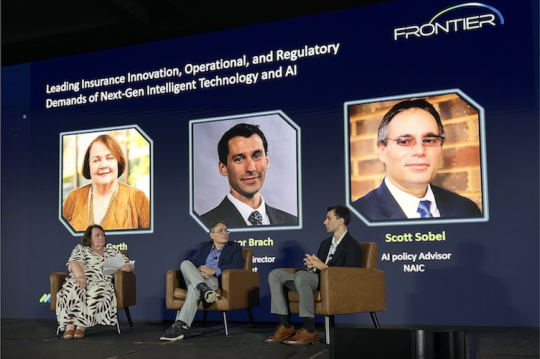
(Denise Garth, Majesco; Scott Sobel, NAIC; and Connor Brach, AM Best at Frontier 2026. Source: IIR.)
Insurers adopting AI need to understand where they use it, how it affects policyholders and what business results it delivers, according to panelists speaking at Majesco’s (Morristown, N.J.) Frontier 2026 conference in New Orleans. In a discussion moderated by Denise Garth, Chief Strategy Officer, Majesco, representatives of the NAIC and AM Best explored the expectations surrounding technology adoption, from oversight of third-party models to the organizational changes required to make innovation effective.
Scott Sobel, AI Policy Advisor, National Association of Insurance Commissioners (NAIC; Kansas City, Mo.), described efforts to help state regulators understand insurers’ AI use and evaluate their governance practices. Connor Brach, Associate Director, AM Best (Oldwick, N.J.), explained how the rating agency assesses innovation alongside the risks associated with its implementation.
Both emphasized the importance of measurable outcomes and oversight. Sobel urged insurers to begin building their AI inventories and governance programs, while Brach recommended moving a few promising use cases into production and demonstrating their business value.
Looking Beyond the AI Label
For Sobel, the regulatory discussion extended beyond generative AI to the consequences of decisions affecting policyholders. Asked what insurers might misunderstand about the NAIC’s work, he acknowledged the difficulty of defining AI and determining which technologies fall within that definition.

Denise Garth, Chief Strategy Officer, Majesco.
Whether an insurer uses a complex model or a simpler calculation, he suggested, the potential effect on a policyholder remains central.
“It almost doesn’t matter how you’re making that decision,” Sobel said. “If you’re making that decision, it affects policyholders.”
The focus, he added, was “potential harm.”
Sobel placed AI within the industry’s history of technological change, recalling transitions from spreadsheets to more sophisticated actuarial methods. New capabilities can reveal limitations in earlier approaches, he observed, even as employees and organizations resist changing familiar practices.
Sobel described AI as a more challenging technological transition for insurers. Its risks were not necessarily entirely new, he said; some could be familiar risks magnified by the technology. He encouraged insurers to establish a purpose for their AI initiatives, set measures of success and monitor whether the systems were moving away from their intended objectives.
From Principles to Examination
Sobel described the NAIC’s progression from AI principles adopted in 2020 to its model bulletin adopted in 2023, followed by work on an AI Risk Evaluation Supplement intended to help regulators examine insurers’ practices.
The supplement, still under development at the time of the panel, comprised four exhibits, he explained. The first addressed the extent and types of AI use within an insurer. Subsequent exhibits covered governance, potentially high-risk models and data.
Those exhibits were intended to operate in a cascade. Depending on an insurer’s initial responses and the regulator’s understanding of its uses, further examination might not be necessary, he explained.
Sobel distinguished the supplement from a recurring data collection exercise. Regulators could request it in examination and analysis settings, he said, but it was not intended as an annual or frequent data call. He also acknowledged the effort required to supply information and said the NAIC sought to minimize that burden while learning which governance provisions proved effective.
“We’re also learning as well,” he said.
His recommendation for insurers over the next 12 months was direct: “Examine your use of AI and start building your AI inventory and governance.”
Third-Party Technology, Insurer Responsibility
Garth asked about the risks insurers assume through their technology suppliers.
Brach cited an AM Best client survey conducted in November 2025 that received 152 responses. More than two-thirds of respondents used third-party vendors for AI solutions, he reported, while only 18 percent identified third-party model risk as a concern.
He described the contrast as surprising and anticipated greater attention to that risk, particularly as the NAIC’s work progressed.
Sobel said regulators recognized the capabilities insurers gained from third-party systems. Nevertheless, insurers remained responsible for their actions toward policyholders and for compliance with applicable laws and regulations.
He described efforts to make obtaining information about third-party technology easier, including information that could help regulators evaluate filings more efficiently. He also distinguished oversight of insurers from direct authority over their suppliers, explaining that regulators’ questions were being relayed to vendors through insurance companies.
Garth raised a related operational concern: technology providers that lacked the resources to continue investing in their products or supplying adequate guardrails. Vendor selection, she argued, required consideration of what the supplier introduced into an insurer’s operating model as well as its ability to support regulatory scrutiny.
AM Best’s Innovation Assessment
Brach explained that AM Best’s assessment of innovation extended beyond the acquisition of technology. Its approach considered innovation within the business profile assessment, evaluated the inputs and outputs of innovation initiatives, and examined associated risks through enterprise risk management.
The input side addressed leadership, culture, resources, and processes and structure. Senior management and board support mattered, he said, as did an organizational culture capable of generating ideas and carrying them through pilots into broader implementation.

Connor Brach, Associate Director, AM Best.
Resources included both funding and people. Processes and structure addressed how innovation was organized across the company, including whether initiatives benefited from participation across functions or encountered friction between silos.
The two output components—measurable results and the level of transformation—received double weight, Brach said. He identified customer retention, expense ratio improvement and loss ratio improvement as examples of tangible benefits.
AM Best also considered how an insurer’s business model compared with those of other insurers and companies outside the industry. Over time, Brach said, he had seen insurers place greater emphasis on refining their innovation structures, allocating resources and demonstrating outcomes.
“People think it’s a technology problem,” he said. “It’s an operating model problem.”
Technology was widely available, Brach observed. Developing the organization’s ability to use it effectively required leadership, resources and changes to how work was performed.
Comparing AI With Actual Human Processes
Garth challenged the assumption that existing manual processes were consistently transparent, trustworthy or repeatable. She recalled a previous panel discussion in which a Microsoft representative had questioned whether insurers applied the same scrutiny to their current practices that they proposed applying to AI.
Sobel extended that point by asking what alternative an insurer should use when evaluating AI’s performance. Human analysts and professionals also made mistakes, he noted.

Scott Sobel, AI Policy Advisor, NAIC.
“Would a human being perform much better always, consistently?” he asked.
At the same time, Sobel emphasized human involvement in consequential decisions. He identified document summarization for underwriting and claims as promising uses that could help professionals navigate an industry rich in processes and information.
Brach argued that governance should scale with the impact of a decision. An AI assistant required a different degree of oversight from a more autonomous underwriting or claims application.
“The more impactful that a decision is, there needs to be a greater level of governance surrounding it,” he said.
Garth expressed a preference for “human in the lead,” a formulation she said better conveyed human control while AI worked behind the scenes.
Modernization and Knowledge Transfer
The panel also addressed the technological and operational constraints insurers bring to AI adoption.
Garth connected legacy systems with the impending loss of institutional knowledge as experienced employees retired. Brach identified knowledge transfer across generations as a potentially important AI use case, alongside underwriting and claims support.
He also described the complexity accumulated through acquisitions and the difficulty of integrating multiple systems. Modernization required reconsidering established processes as well as adapting the technology, he said.
Smaller and midsize insurers could have advantages in making those changes, the panelists suggested. Brach pointed to their potentially lower complexity and greater agility. Sobel cited closer relationships among employees and shorter distances between staff and leadership, which could help communicate a common vision.
In closing, Brach urged insurers to select a couple of use cases capable of producing significant, measurable outcomes and move them beyond the pilot stage. Sobel emphasized communication with the people involved at each level of implementation, openness to feedback and the value of achieving a smaller, demonstrable success.
“Go for a small win,” Sobel said, “maybe not necessarily a home run.”
Majesco’s Elster Links AI Value to Rethinking Legacy Processes