
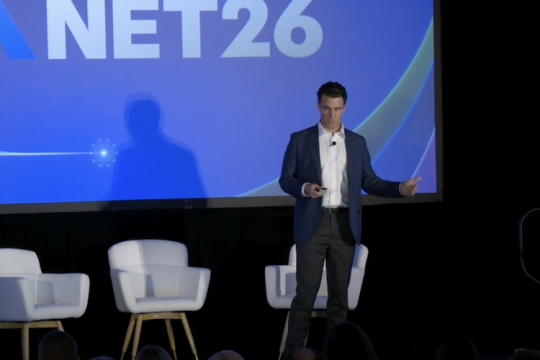
(Michael Streit, President, Applied Carrier, onstage at Applied Net 2026. Source: Applied Systems.)
Applied Systems’ acquisition of Cytora is expanding its relevance to carriers, building on its longstanding position in agency management and distribution technology. At Applied Net 2026, executives described how the combination of Cytora’s risk-processing capabilities, Ivans connectivity and Applied’s agency platforms is beginning to change how carriers receive, evaluate and quote commercial business.

Michael Streit, President, Applied Carrier.
The opportunity centers on a familiar source of insurance inefficiency: the exchange between distributors preparing risks for placement and carriers determining whether and how to underwrite them. Applied’s approach connects those activities more closely, using AI to interpret information in existing documents and systems while preserving the requirements of individual carriers.
For Applied Systems (Chicago), the acquisition of Cytora (London), announced in September 2025, adds a carrier-facing risk-processing platform to technology already embedded in agency operations. The resulting capabilities range from automating emailed submissions to generating competing renewal quotes from information an agency already holds—before an account manager begins assembling a remarketing package.
“We know that we are only effective when we contemplate both sides of the risk transfer process,” said Michael Streit, President, Applied Carrier, in his keynote.
From Connectivity to Risk Processing
Applied’s carrier connection has an established foundation in Ivans. Streit traced the network’s origins to insurers’ efforts in the early 1980s to overcome expensive, difficult-to-scale connections between individual carriers and agency systems. Today, he said, more than 700 carriers send hundreds of millions of transactions to more than 30,000 agencies through that infrastructure.
His argument was that a similar opportunity now exists around AI: transformative technology needs a network through which its capabilities can reach both sides of a transaction.
Commercial placement remains an example of that unfinished work. Agencies assemble forms, loss runs and schedules, send submissions by email and then wait with limited visibility into the carrier’s process. Underwriters identify missing or contradictory information, ask for more data and move information between systems. Small commercial placement introduces a related burden: entering much the same information repeatedly in different carrier portals.
Streit linked those administrative costs to a larger commercial problem. Carriers that respond slowly can lose opportunities to bind business, while brokers expend effort approaching markets that may not want the risk. He also argued that response speed can affect portfolio construction as faster competitors secure business first.

Juan de Castro, COO, Cytora.
Cytora addresses the carrier side by digitizing risk information according to the insurer’s own requirements and managing the iterative exchange as additional information arrives. Streit emphasized the ability to recognize subsequent communications as part of an existing submission and update downstream systems, rather than treating each document as a separate intake event.
For Juan de Castro, President, Cytora, Applied ownership extends the reach of an existing mission.
“It’s not altered. It’s accelerated,” de Castro said of that mission in an interview with IIR.
Cytora initially concentrated on inefficiencies within carriers: capturing submission data, obtaining external information, applying appetite guidelines and routing risks to the appropriate workflow. Simple risks could move to quoting APIs; complex ones could reach underwriters with information collected and systems populated.
The acquisition creates an opportunity to address the surrounding exchange, including which carriers receive a risk and what information accompanies it. De Castro describes three concurrent activities: continuing to develop standalone Cytora, using its capabilities within agency products, and orchestrating agency and carrier processes together.
Quoting Before Remarketing Begins
Submissionless remarketing provides the clearest example of that orchestration. An agency records its placement strategy in Epic, Applied’s agency management system, including the carriers with which it wants to grow. A renewal-related event triggers the process, and Cytora identifies the information participating carriers require to quote the risk.
The platform then retrieves relevant data from agency records and documents, supplies it in the form each carrier requires and returns available quotes within the agency management system. Where information is missing, Streit describes a human-in-the-loop process to obtain it.
“Submissionless” refers to removing the broker’s manual assembly of a conventional submission package. Risk information still passes between distributor and carrier, but the process can begin without an account manager separately preparing and sending the documents.
The arrangement also incorporates agency decisions about where to place business. Streit described filters such as geography, account size and participating carriers, intended to direct opportunities toward markets with which the agency actually wants to trade.
Both Streit and de Castro reported that initial submissionless transactions for renewal business began flowing in the week preceding Applied Net. Streit identified Chubb (Zurich), Liberty Mutual (Boston) and Travelers (New York) as anchor carriers. The start of transactions advances an initiative announced in July with Travelers as the first anchor participant.
“The submissionless capability begins with renewal business; extending connected trading to new business remains a planned next stage. De Castro describes an intended experience in which carrier appetite and information requirements become visible as an agency begins developing a risk. That would allow brokers to identify suitable markets and assemble the necessary information before sending a submission and discovering what is missing.
Preserving the Carrier’s View of Risk
The objective is to make the exchange easier without imposing a uniform underwriting approach. De Castro emphasizes that carriers differentiate through their view of risk: the information they consider significant, their segmentation, and how they price and establish terms.
Two carriers evaluating the same property may require different data. Cytora’s role is to capture and supply those requirements while leaving the underwriting strategy with the insurer.
“We want to protect each carrier’s view of risk,” de Castro said.
Rajat Kongovi, SVP, Applied Systems, explained the corresponding agency work in an interview with IIR. His responsibilities cover agency commercial lines products and agentic AI, and his collaboration with the carrier team centers on how agencies prepare submissions, receive responses and communicate with underwriters.
Submissions Manager is intended to provide a common working location for activity that currently spans email and separate tools. Kongovi described consolidating submission status and carrier communications, with additional submission channels to be brought into that environment.

Rajat Kongovi, SVP, Applied Systems.
Streit said the product was live with pilot agencies, with broader release planned for the fall and early winter. He presented it as a foundation for further connectivity, including appetite signaling, moving blocks of business and additional workflows.
Kongovi’s explanation also clarifies what Applied means by standardizing the exchange. Participants need not all supply identical information in an identical format; AI helps translate what they provide into the recipient’s required form.
That approach supports an adoption principle he describes as introducing AI within existing working practices.
“Keep working the way you’re working, but let me help you introduce how AI can help you within the way you’re working,” Kongovi said.
Email-to-quote illustrates the principle. Brokers send the documents and information they have; Cytora interprets the material, maps it to carrier rating APIs and returns a response. Streit identified Liberty Mutual as a carrier working with Applied to deliver the capability.
Applied’s August announcement describes email-to-quote as supporting admitted small commercial lines where carrier straight-through-processing APIs are available, regardless of the broker’s agency management system. It offers a route to automated quoting through a channel brokers already use.
The Business Case for Connected Trading
Applied describes the broader effort as “connected trading,” encompassing closer coordination between agency and carrier workflows. Kongovi said the term is not currently an industry-standard term of art; in Applied’s usage, it also expresses an ambition to bring more of the conversation following submission and quote onto the platform.
De Castro connected the carrier business case to productivity and responsiveness. He said many Cytora clients have more than doubled productivity measured as gross written premium per full-time employee. He also reported client analyses showing that responding first can increase quote-to-bind conversion by 50 percent—for example, from 20 percent to 30 percent.
The scope of automation remains a carrier decision. De Castro distinguished removing non-value-adding administration, providing insights to underwriters and routing simple risks through automated processing from the much broader prospect of autonomous underwriting across complex commercial business.
The immediate proposition is to give underwriters prepared information and more time for judgment and broker relationships. For Applied, Cytora makes that proposition part of a larger connection to distribution: carrier requirements can inform agency preparation, and carrier responses can return directly to the workflow where placement decisions occur.
“Welcome to the new era of risk transfer,” Streit told attendees. The initial transactions, pilot deployments and planned extensions give that ambition a concrete starting point—and carrier technology buyers more reason to consider Applied’s role in how business reaches their underwriting operations.